Daddy-Daughter Take on Reed’s Dairy

Reeds2

You have heard the motto, “Go West, young man, go West”.  For the citizens of Idaho Falls, a treasure of milk and cream awaits you as you travel on Broadway to the western edge of the city.  Reed’s Dairy has a reputation for the best, fresh bottled milk, large scoops of ice cream, and even homemade waffle cones.  My family and I arrived there on Tuesday night.  Ten cars parked in the front parking lot.  Thirty plus people, licking and laughing, chomping and chattering, hovered around the front counter where Nick and Jessie scooped up all assortments of flavors from the series of ice cream tubs.  It was standing room only, bursting the occupancy codes at the seams.

Reeds1

I purchased ice cream for my family, except my youngest son.  He got a big ol’ waffle cone for free!  Lucky guy! At the beginning of the year, in a Reed’s Dairy contest, he guessed the closest number to the amount of candies in a large, glass container.  The happy boy received fifty-two certificates for weekly free ice cream through the entire year of 2015.  Mr. Reed is a clever marketer; it is all free for my boy, but I think that I have spent more money on Reed’s Dairy ice cream for myself and my other four family members this year than all the other years together.  And yet I must say its money well spent.  Eating ice cream puts a smile on your face.  Soon you will be skipping along with me and singing this song,

Reed’s is a dairy, making you merry.

Past the outside poo, enter for the sweet goo.

Whether young, or old, enter one, and all,

Cookie cream berry, such pleasure to carry.

There wasn’t any room inside, so we walked back outside as more people piled in.  We sat on the little wooden bench under a flickering fluorescent light.  It wasn’t long before my wife was getting the chills, so we all jumped back in the family minivan.  My daughter, Mariah, mischievously giggled and laughed.  Was it the ice cream?  Jokes about her brother?  Listening to her mother instruct me on how to drive? Or this new adventure of joining together with me on writing “Daddy Daughter Takes”?  I couldn’t help but laugh in harmony with her.

She audibly burped.  Silly girl.  Of course, in some countries that is the way to express gratitude.  I wonder if that is what Canadians do when they enjoy my sister Debbie Falconer’s famous business, The Old School Bus Ice Cream in the major tourist area of Canmore, Alberta.

Making a trip to Reed’s Dairy, you might sing, laugh, or burp, especially if you are with my family.  But whatever you do, sample all the flavors.  Say hi to the baby calves.  And look up into the big Idaho sky and thank God for family, friends, and ice cream.

Posted in restaurant reviews | Tagged , , , , | Leave a comment

Shepherding God’s Flock

Title – Shepherding God’s Flock:  Biblical Leadership in the New Testament and Beyond

Editors – Benjamin L. Merkle and Thomas R. Schreiner

Publisher – Grand Rapids:  Kregel, 2014

The following eleven men contributed chapters to this book:  James M. Hamilton Jr., Andreas J. Kostenberger, Benjamin L. Merkle, Thomas R. Schreiner, Michael A. G. Haykin, Gregg R. Allison, Nathan A. Finn, Jason G. Duesing, Shawn D. Wright, Bruce A. Ware, and Andrew M. Davis.

I read this book in the order of my interest:

First – Shawn D. Wright on chapter 9, “Baptists and a Plurality of Elders”

Second – The introduction and then chapters 1-4

Third – The conclusion, chapters 10-11

Fourth – Chapters 5, 6, and 8 on Catholicism and Anglicanism

These men would reflect my conviction on church governance – congregational rule with elders leading and deacons serving.  The biblical terminology of overseer, elder, and pastor refer to the same church office.  And each congregation should strive to recognize and honor in their midst, a plurality of shepherds.  There are leaders in the church but the final court of appeal and authority is the church congregation.

Posted in Uncategorized | Leave a comment

Broken-Down House

broken house1

Title – Broken-Down House:  Living Productively in a World Gone Bad

Author – Paul David Tripp

Publisher – Wapwallopen: Shepherd Press (facebook), 2009

You ought to read this book.  Paul Tripp explores beyond your pious facades and intersects deeply with the brokenness of your spirits.  He delves into the issues of the heart.  But he will not come at you as the criminal prosecutor but as a fellow brother desperately needing the same grace of God for his own struggle and war against sin.

Tripp follows the pattern of the apostle Paul on the gospel.  First, there are things that you ought to know.  Secondly, here is what gospel grace will lead you to do.  There is no better transformational agent, righteous teacher, relentless trainer, and life coach for your life than God’s gospel grace.

Every Christian home ought to have a copy of this book on their living-room shelf.  And this message is the key for the neighborhoods of your city.

Posted in Uncategorized | Leave a comment

Searching for a Shepherd

Title – Searching for a Shepherd (revised 2011)

Author – Steve D. Spacek

Ministry – Help Ministries

Steve has written “A Pulpit or Search Committee’s Handbook”.  The handbook contains five sections:  the presuppositions, the preparation, the procedure, the postscript, and the precautions.  The handbook also lists a number of helpful profiles, letters, and forms in the appendix.  All the information can be easily adapted for independent Bible and Baptist congregations.

Posted in book reviews | Tagged , , , , , | Leave a comment

Well-Intentioned Dragons

Title – Well-Intentioned Dragons:  Ministering to Problem People in the Church

Author – Marshall Shelley

Publisher – Minneapolis:  Bethany House Publishers, 1994 edition

In this book, Marshall shares many stories on conflicts that pastors may have with fellow elders or influential members within a local congregation.

He gives titles to people:  (1) the bird dog, (2) the wet blanket, (3) the entrepreneur, (4) captain bluster, (5) the fickle financier, (6) the busybody, (7) the sniper, (8) the bookkeeper, (9) the merchant of muck, and (10) the legalist.

All of these types of people in different ways can hamper the preacher in his calling and distract him in his own personal walk with God.

Here are characteristics of dragons:

  1. “The worst dragons may be, in the beginning, the pastor’s strongest supporters.”
  2. “Dragons often work overhard initially at befriending you.”
  3. “Dragons usually compare you to their former pastor.”
  4. “Dragons thrive when the church’s formal authority and informal power structure don’t match.”
  5. “Dragons are often bred in counseling.”
  6. “Dragons often sensed a call to the ministry at one time.”

Here are some quotes that stood out to me.

“Resolved:  that all men should live for the glory of God.  Resolved second: that whether others do or not, I will” (Edwards, p. 49).

“When attacked by a dragon, do not become one” (p. 61).

“It’s doubtful that God can use any man greatly until he’s hurt him deeply” (Tozer, p. 80).

“Part of the miracle of grace is that broken vessels can be made whole, with even more capacity then before” (p. 80).

“Criticisms can’t be ignored, nor should they be allowed to set the direction for the church” (p. 115).

“The only times public action is ever appropriate is for continuing, confirmed, and unconfessed sin.  And never unless the leadership of the church supports the move.  Bringing things into the open too quickly is more dangerous than waiting too long.  Rather than forcing the issue publicly, often more is gained by learning to minister in an unresolved situation” (p. 132).

“It is a fact of Christian experience that life is a series of troughs and peaks.  In his efforts to get permanent possession of a soul, God relies on the troughs more than the peaks.  And some of his special favorites have gone through longer and deeper troughs than anyone else” (Marshall, p. 133).

“True love isn’t even learned among friends we have chosen.  God’s kind of love is best learned where we can’t be selective about our associates.  Perhaps this is why the two institutions established by God — the family and the church — are not joined by invitation only” (p. 148).

In summary, I do know this.  Patience, courage, love, humility, gospel repentance and growth, and Christ-likeness – these characteristics are all forged in the fires of conflict.

Posted in book reviews | Tagged , , , , , , | Leave a comment

A green, olive tree

Today’s read in The NKJV Daily Bible:

But I am like a green olive tree in the house of God;  I trust in the mercy of God forever and ever – Psalm 52:8.

Posted in Uncategorized | Leave a comment

Zephaniah 2

Zephaniah 2

Observation Questions

  1. How is the nation described? (verse 1)
  2. How many times do you see the day of the LORD?
  3. What is the imperative used 3x in verse 3?
  4. Who are the nations being judged?
  5. Why are they judged?
  6. What are the key words in this chapter?
  7. Where would you divide the paragraphs?
  8. How would you summarize each paragraph?
  9. What will the remnant do in the day of the LORD?

Interpretation Questions

  1. Where are the cities in this chapter located?
  2. Who are the Cherethites?
  3. Where are the various nations located?
  4. When is the day of the LORD?

Application Questions

  1. Will there be a day of the LORD today in the Middle East?
  2. Will there be a day of the LORD today in America?
  3. Do I take the warning to seek God? To uphold justice?  To exhibit humility?
  4. How can one be hidden from the wrath of God?
Posted in Inductive Bible Study | Tagged , , , , | Leave a comment

Zephaniah 1

Zephaniah 1

Observation

  1. Read through the chapter in different translations.
  2. Read through the chapter in your preferred translation several times.
  3. Highlight the phrase where “day” is used.
  4. How many times do you see the LORD’s name (YHWH)?
  5. Mark the places.
  6. When you see quotes in chapter one, who is speaking?
  7. List all the “I wills” of God.
  8. What is the Hebrew idiom behind the translation, “settled in complacency”?
  9. What attributes of God do you see displayed?

Interpretation

  1. What does the name “Zephaniah” mean?
  2. What are “idolatrous priests”?
  3. What does it mean “worship the host of heaven on housetops”?
  4. What is “Milcom”?
  5. What does it mean that “the LORD has prepared a sacrifice; He has invited His guests.”
  6. What does it mean to “leap over the threshold”?
  7. Where is the Fish Gate? The Second Quarter? How about Maktesh?
  8. What is the great day of the LORD?
  9. What are the main points of chapter 1?
  10. What is the main theme of the chapter?

Application

  1. Rather than believe Deism, how do you know that God is personal and active in our affairs?
  2. How might our culture be mixing faith in God with pagan idolatry?
  3. Do we have any excuses for when God’s judgment strikes?
  4. Are you fearful of the Day of the LORD? If you are in Christ, should you be afraid?
  5. God shakes up complacency. In what ways does He do that in your life?
  6. In what areas of our lives, do we need the Lord to purge us from complacency?
  7. How do people try to safeguard themselves from disaster? What is the best safeguard?
  8. How has God displayed His jealousy in your life?
Posted in Uncategorized | Leave a comment

Rooted

DSC02214

My youngest boy planted this during the Earth Day celebration in Idaho Falls.  This reminds me of what was pointed out to me by a Christian brother in a downtown coffee shop, yesterday.

As you therefore have received Christ Jesus the Lord, so walk in Him, rooted and built up in Him and established in the faith, as you have been taught, abounding in it with thanksgiving.

I have a glorious home.  I have been firmly rooted in the Messiah.  I ought to be the most thankful man in the city.

Posted in testimony | Tagged , , , , , | Leave a comment

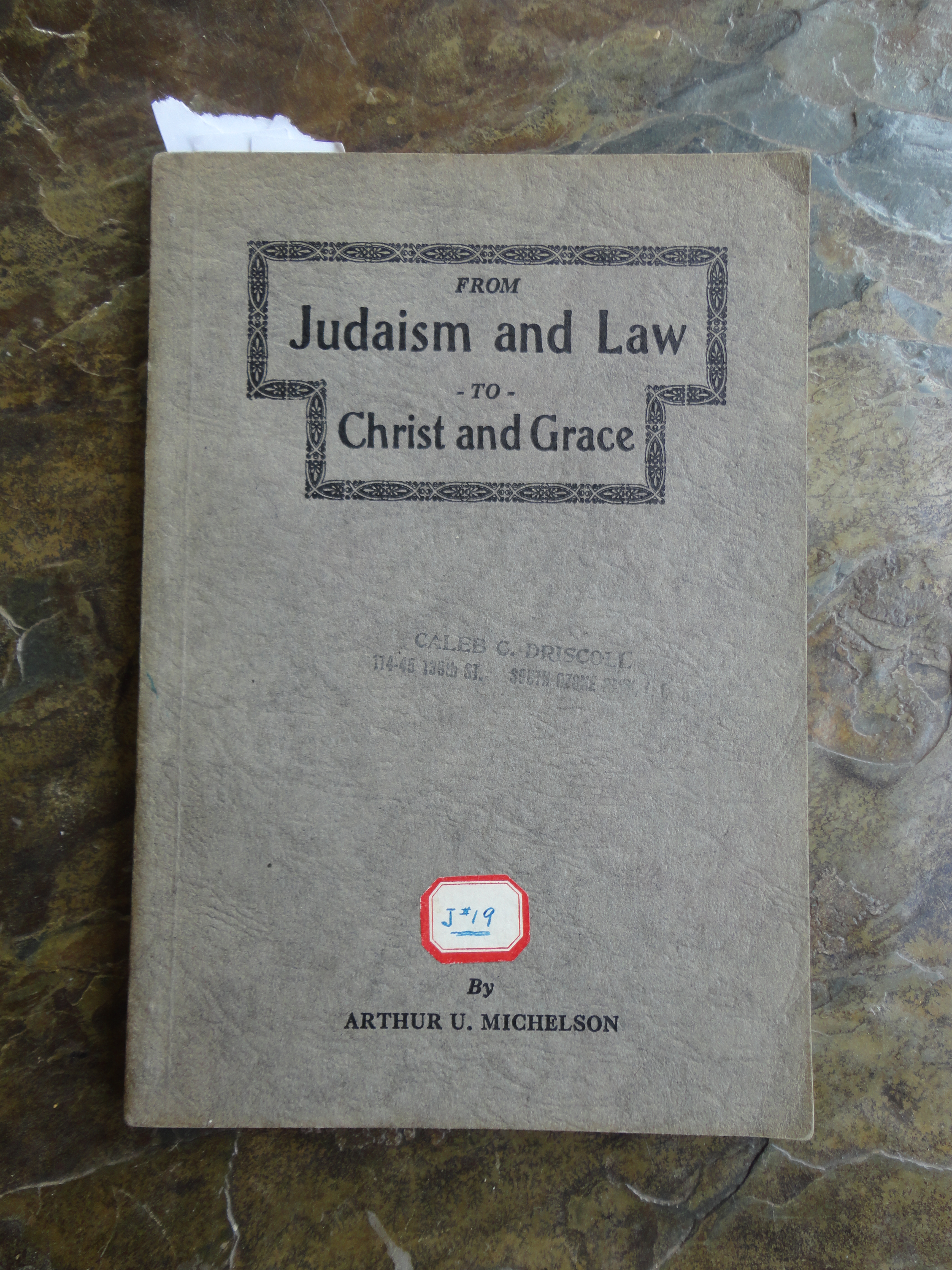
From Judaism and Law to Christ and Grace

DSC02204

Title – From Judaism and Law to Christ and Grace

Author – Arthur U. Michelson

Publisher – Los Angeles: The Jewish Hope Publishing House, 1934

This is a fascinating window into early Jewish evangelism in America before World War II and the establishment of Israel as a nation.

Arthur grew up in an orthodox Jewish household in Germany.  He recounts the passion that his father displayed for the festivals, prayers to the dead, and continual repentance for sins.  He shares his childhood struggles, the yearnings for peace, his marriage, his intersection with Roman Catholicism, his diligence in his law career, his encounter with Jesus Christ that changed everything, and his persecution by orthodox Jews.

Here is an example of family persecution.  Philip in Brooklyn, New York told his mother in Germany that he accepted Jesus Christ as his Savior.  Five months later, she mailed him these words:

Philip:  You are no longer my son.  We have buried you in effigy; we mourn you as one dead.  And now may the God of Abraham, Isaac, and Jacob strike you blind, and deaf and dumb, and damn your soul forever.  You have left your father’s religion and the synagogue for the imposter, Jesus, so now you may take your mother’s curse.  Jane

Three weeks later, from his heart, he wrote this moving, poetical testimony to his mother:

  • Far away from home, my mother,
  • Daily will I pray for thee.
  • Why should I be cursed, my mother?
  • Why such a message sent to me?
  • Once convinced of sin, my mother;
  • I cried and Jesus set me free.
  • I am happy, now, my mother,
  • Christ, the Jew, has died for me.

__

  • Him you taught me to hate, mother,
  • Him you still impostor call.
  • Died for me on Calv’ry, mother,
  • Died to save me from the fall.
  • Let me lead you to him, mother,
  • While I pray on bended knee,
  • “Jesus, now accept my mother,
  • Loving Jesus, set her free.”

__

  • Be persuaded, dearest mother,
  • Do not now so hardened be.
  • Jesus Christ, the Jew’s Messiah,
  • Surely died for you and me.
  • Can you spurn such mercy, mother?
  • Can you turn away your face?
  • Come to Jesus, come, dearest mother,
  • Fly, oh fly to His embrace.

Eventually, God brought the Michelson family to America.  In 1928, Arthur founded the Hebrew Evangelization Society in Los Angeles, California.

His advisory board consisted of the following pastors:  H. Eilertsen, Alfred Inwood, O. D. Ironmonger, E.B. Joseph, Wm. Kirby, E.A. Lacour, H.B. Macrory, W. F. Ploat, A. J. Smith, Oswald J. Smith, Jacob Stocker, and John W. Underwood.

Jewish ministry progressed.  Arthur wrote,

When the Lord called me into His work He gave me the vision of establishing a Hebrew Christian Synagogue in order to bring Jews and Gentiles together, in the brotherhood of love which Jesus Christ proclaimed.  I had spoken with several ministers about it but it seemed to them an impossibility and I found no encouragement.  One day, while working in the Jewish Ghetto on the east side of Los Angeles the Lord led me definitely to an empty corner on Michigan and Chicago, and while looking at it, the Holy Spirit signified to me so plainly that this was the place for the Synagogue.  We prayed and the Lord made it possible for us to buy the place.  In March 1931, we moved out to our new headquarters, at 2209 Michigan avenue, and built a temporary meeting place which was dedicated as the “First Hebrew Christian Synagogue,” on the 24th of May, 1931, by a converted Jewish rabbi, Max Wertheimer, who came from Ada, Ohio, for that specific purpose.  Songs of Jews and Gentiles filled the place and the glory of the Lord was present.

Several years later, the permanent Synagogue was completed.

Proper arrangements were made to complete the Christian Synagogue which we finished the beginning of March, 1934.  The dedication of the completion took place on the 11th of March, which was a great service.  It was the first time in the history of the church that such a Christian Synagogue, in such form and structure, was established, because it combines in its architecture Judaism and Christianity.

Arthur Michelson integrated Judaism and Christianity thus:

  • “It seems hard to make a Jew understand that to believe in the Gospel of the Messiah is to believe in the real and true Judaism.”
  • “But as a matter of fact, Judaism and Christianity are not different, they are one and the same.  Christianity is Judaism fulfilled; Judaism is Christianity promised; Christianity is Judaism unfolded; Judaism is the root and Christianity is the fruit; what is concealed in the Old Testament is revealed in the New.  The one is supplemented by the other.”

The latter half of the book shares encouraging gospel testimonies by Miss Frances Stein, Harry Epstein, Mrs. Rose Klein, Isadore Rohr, and Judge Chas. F. Cook.

Posted in book reviews | Tagged , , , , , | Leave a comment