Saeed Abedini and David’s Prayer

My heart is full of emotion today as I read news about the release of Idaho brother, Saeed Abedini.  I soak my mind in God’s Word, and here is one among many of the psalms that speak for my heart.

Make haste, O God, to deliver me!  Make haste to help me, O LORD!  Let them be ashamed and confounded who seek my life; let them be turned back and confused who desire my hurt.  Let them be turned back because of their shame, who say, “Aha, aha!”

Let all those who seek You rejoice and be glad in You; and let those who love Your salvation say continually, “Let God be magnified!”

But I am poor and needy; make haste to me, O God!  You are my help and deliverer; O LORD, do not delay. – Psalm 70

Posted in devotional, Scripture, Uncategorized | Tagged , , , , , , | Leave a comment

End of the Spear

spear

I wrote this ten years ago:

Before I plunge into a book review, may I render a little history lesson?

At age 21, a man wrote of the coffin:  “a swallowing up by Life.  For this I am most anxious.”  At age 21, he scribbled on paper, “Only I know that my own life is full.  It is time to die, for I have had all that a young man can have, at least all that this young man can have.  I am ready to meet Jesus.”

I have on my shelves, basically every published statement he has written and later on that his wife had written about him.  Outside of the direct calling of God, he was the primary human instrument in my life for pursuing a mission’s major at Bible College (though he was a Greek major).

At college, I listened to discussion labeling him “foolish”, “unwise”, “not thinking about family”, etc.  But even to this day, he is one of those chief passion igniters in my life.  It’s Jim Elliot.  My heart beats strong over the topic of frontier missions.

Over the last year’s Thanksgiving weekend (when I was sicker than a dog), I watched the latest and greatest DVD from the local library, Beyond the Gates of Splendor, from Bearing Fruit Communications, produced by Kevin McAfee [2005].  I got upset afresh in watching the complete lack of communication, the hush-hush mentality over all the proceedings that took place on the Curaray.  I would have been furious as Nate Saint’s seasoned missionary sister, Rachel.  But you know, if I had lived back in the 1950’s, and Jim as a Wheaton grad had asked me to join the team, I probably would have hopped right in with him and his crazy friends.

January 8, 2006 is the fiftieth anniversary of Nate, Jim, Roger, Pete, and Ed’s coronation.  A lot has happened in fifty years, especially when Nate Saint’s grandson, Jesse, made one of the killers his adoptive grandpa.

With a movie about to hit the movie theaters, January 20, let me introduce you to Steve Saint’s intriguing, missionary book – End of the Spear.

The prologue immediately tugs you into the world of the Amazon.  What I would have given, to listen and see the dumbfounded expression of University of Washington college students sitting with the Waodani, realizing these were the famed Auca (“derogatory term that means ‘naked savage’ ”) of the 1950s.  Understanding awakened when they heard one violent story after another to the question, “Bito maempo ayamonoi?” meaning “Your father—where is he being?”

Yet now, no one, anthropologist, environmentalist, etc. can deny the remarkable, supernatural transformation marking the lives of Mincaye, Kimo, and Dyuwi, and the work trickling down through family members of the tribe.  A little over ten years ago in the “little rustic house” of his Aunt Rachel, Steve discovered who thrust the spear through the temple of his dad’s head, making him fatherless at the age of five.  But the book leads you into a powerful climax of emotions when the murderer of Nate Saint becomes one of the chief rescuers in pulling the adult, Steve Saint from the “black cloud of despair” in his darkest hour.  In a chilling moment when he could feel his own “faith slipping away”, the killer of his dad showed faith, becoming his “lifeline” and anchoring him in the sovereign goodness of a loving God.  Unmistakably, one may trace the imprint of God even in the most savage storms of life.

I am extremely thankful for Steve’s descriptions in the book of his Aunt Rachel, her renouncing the immense financial wealth of a Philadelphia woman, her bull-dog tenacity (along with “Aunt Betty”, alias “Woodpecker”, with her in the early days) to live among the tribes, and her faithfulness to Christ among these people till cancer took her body.  She reminds me of the Rachel character in the John Grisham’s 1999 novel, The Testament, but only far greater, the real thing, the genuine servant of Christ, “acceptable to God, approved of men.”  In 1994, Kimo shared choice words at her funeral, “Waengongi Taado ante odomoncaete ante Nemo pongantapa” – Teaching us to walk God’s trail, Star came.

One night while my wife and I were having dinner together alone at a nice, cozy Mexican restaurant, I read to her this little excerpt sharing Steve in a discussion with his aunt:

“Just before I said goodbye to Aunt Rachel after our last filming session, she grew uncharacteristically sentimental.  ‘Isn’t it something,’ she asked, ‘that the Lord Jesus would have used someone like me to do His work in this special place?  I was too old by the time I could apply for missionary service.  I couldn’t help the Waodoni much medically, I was not a Bible scholar, and I was never really a superior translator.’

‘Well, Aunt Rachel, why do you think God gave you this assignment?  What do you think He saw in you that He could use?’  Her eyes brightened, and this eighty-two-year-old hero of mine responded with a formula for living:  ‘Well, Stevie Boy, I loved the Lord Jesus with all my heart, and I trusted Him completely.’ She paused before continuing, ‘And I guess I just learned to persevere in whatever He gave me to do.’

I looked up to see the tears in Kristie’s eyes.  Choking with emotion, I could hardly finish reading the rest of the page.  Amid chips, salsa, fajitas, rice, and refried beans, we were quite a sight, but touched by this faithful servant of God, Rachel Saint, and oblivious to those around us in the café.

Pivotal in life direction, after the burying of Aunt Rachel in November of 1994, a tribal grandmother, Dawa, persistently brought up an idea, changing Steve and his family’s destiny.  “Now Star, who is dead—being buried, we say you come live with us!”  Any of us would have hyperventilated; Steve actually parleyed, but really how can you say no to family?

Interestingly, healthy anger over callousness to the Waodani people provoked Steve Saint to live again among his tribal family.  Emotions rushed over him when he listened to the glib statements of tourists at a bush airstrip at Tonampade.  “Did you know that these are the people who killed five missionaries?  We just came back from the beach where they did it?”  It stirred within him protection for a people needing help.

I can somewhat identify.  At one time, over a decade ago, the director of a large mission board, chuckling, told me in my indecision over place of future ministry, “I think I would rather minister to the Africans than the Mormons.”  My emotions flared.  And I could have said with Steve Saint, “Without knowing it, I had just crossed the first line of decision.”  Ironically, while Steve sought ministry in South America, I minister where Steve’s mom grew up – the great state of Idaho.

At this juncture in the book, Steve intimately explores the whys and hows, which have been on people’s minds for fifty years concerning what happened on Palm Beach, a story that he had not possessed in such detail since forty years ago when his hero had been taken from him.  In the chapter on “Friendly Friday”, the author reveals the explosive and jealous love triangle between Dyuwi, Gimade, and Nenkiwi and the fierce responses of the tempo member of the tribe, Gikita, over Nenkiwi’s lies.  (Incidentally, key for me in this chapter, though I still don’t agree, Steve helps me overcome a little of my incredible frustration over the five men’s secrecy, hiding their plans from extended family and mission agencies.)

The chapter “Did They Have to Die?” reconstructs the whole scenario of Palm Beach, blow by blow, of how each missionary died.  Steve powerfully answers four questions by the Waodani:

“1.  Why did one of the foreigners raise his arm as though he was going to spear Nampa after Nampa had speared him?

  1. Why was there no door on the plane so Nimonga could spear the foreigner who climbed into the plane after the spearing started?
  2. Why was that foreigner trying to eat something in the plane during the attack? Surely it was strange even for foreigners to stop to eat when they were being attacked.
  3. Why did one of the foreigners stand on a log and call to them instead of fleeing so he could live?”


The chapter concludes with conviction, “There are too many factors that all had to work together to have allowed the events to happen as they did.  Too many for me to believe it was chance.  I have come to the conclusion that God did not look away.  He did not simply allow this to happen.  I think He planned it.  Though this has not been an easy conclusion to come to, I believe it is the right one.  I have personally paid a high price for what happened on Palm Beach.  But I have also had a front-row seat as the rest of the story has been unfolding for half a century.  I have seen firsthand that much good has come from it.  I believe only God could have fashioned such an incredible story from such a tragic event.  I could not begin to record the thousands of people who have told me that God used what happened on Palm Beach to change the course of their lives for good.”  I have never mentioned this to any of the families of the five men of Palm Beach; but I write it now, clearly and honestly, please place me in the category of those people.


When I read Steve’s account of breaking the news to his dear wife, Ginny, I could only think of words written by Jim Elliot in 1952, “The will of God is always a bigger thing than we bargain for.”  For Ginny and the four teens, Shaun, Jaime, Jesse, and Stephanie, it would be a new world of six-inch coachroaches, inch-long mani (ants), “clucking” maggots out of bodies, monkey meat, mashed plantain mixed in water, G-strings, thatched huts, balsa earplugs, blow darts, vampire bats, and anacondas.  But God gave Ginny the desire to sing with the natives.  And the teens would soon become Tonae, Mincaye, Yeti, and Nemo.


The heart of the book is the establishment by God’s grace of the “little community of Star Creek” – Nemompade.  This became the medical, educational, and supply headquarters for all the God followers and the trigger for Steve’s current ministry, I-TEC, the Indigenous People’s Technology and Education Center (www.itecusa.org).


Steve never wanted the people to become dependent on him.  The discussion on building philosophy is fascinating, pertinent to so many on the field.


“On my weeklong trek, I had noticed that none of the Waodani villages had God’s houses.  Tiwaeno had once had one, and so had Tzapino.  Now they didn’t.  I asked the People why.  They simply said that they couldn’t build them.  Of course they could, I told them.  They could build a Waengongi onco in the same way they build their own oncos!  They explained that they could only build druanibai—like the ancient ones had—not ‘proper’ churches.


As the conversation went on, I realized that when outsiders had built the crude little board church in Tonampade, with cement posts and a tin roof, everyone decided that this is what a ‘proper’ God’s house should be like.  The Waodani didn’t know how to make boards, they didn’t know what that mush was that got so hard and supported the building, and they didn’t have money to buy tin roofing.


The Waodani in Tonampade would not even attempt to fix the church floor, which had begun to rot.  When I asked them why they didn’t fix it, they said they couldn’t because they did not have permission. ‘Permission from whom?’ I asked.  They didn’t know the answer to that, but what they did know was that they had not built it or paid for it.  They did not know whose it was, but they knew it definitely was not theirs.


I realized that if the community we were planning to build together was going to really be theirs, they would have to build it.  That was especially critical of the airstrip.”


To prove fully, he didn’t want the people dependent on him.  Steve made the heartbreaking decision after a year and a half to pull his family away from the Amazon.  In anguish, July 21, 1996 became that “fateful day”.


Acclimatizing back in the culture of Disney World proved harsh for the family.  Steve writes at the close of a journal he kept, “Six thousand dollars a year for insurance because we have teenage drivers, even though not one has ever been drunk, all are excellent students, and they have never gotten tickets.  We pay for many people who don’t care, aren’t responsible, and have little to lose” . . . “We fill our days with entertainment and activities, buying appliances and gadgets to cook, wash, bake, and compute, and generally relieve us of living, so that we can spend more time exercising to get in shape because the gadgets and machines are doing all our work.  It is hard to live here and not go along, but I am more and pleased with how we lived in the jungle.  Very nice to be all together as a family, however.”


For all who have been captivated by the Palm Beach incident of fifty years past, Steve’s book is a must read.  His transparent, self-effacing humor, his sensitivity to the culture, his humility in correcting Western thought, his love for his tribal family, and his compassion for the struggling are refreshing.


During the summer after my senior year of high school almost twenty years ago, I poured over the journals of Jim Elliot on a rimrock butte in the high deserts of Oregon.  He enflamed my heart to journal, to make God number one in my life, and to live only for missions.  Reading this book, Steve captures the heart attitude you must have for others while on the mission field.  He portrays a treasured dimension—family.  Warm, vibrant, relational family.  What a far cry this is from the sterile, programmed professionalism of ministry in the West.  Though we are not in the same associations of ministry, we thank you, Babae, for writing down your story that is all about God’s story in End of the Spear.  May Waengongi and His Son, Itota, be praised!

Posted in book reviews, Uncategorized | Tagged , , , , | Leave a comment

My oldest daughter’s testimony

I decided to follow Jesus Christ when I was very young. I knew I was a sinner who could never reach heaven without God.  Romans 3:23 states a universal truth, “For all have sinned and fall short of the glory of God.” My life was filled with evil; I was the top priority, and no one else mattered. However, my Dad had discussed with me that God is love and how this is demonstrated through the Person of Jesus Christ.  John 3:16 joyfully proclaims, “For God so loved the world that He gave His only begotten Son, that whoever believes in Him should not perish but have everlasting life.” This opened my eyes. My God loved me so much that He would give His only Son as a sacrifice in order to save me, a guilty sinner under the curse of the law. Christ’s sacrifice showed me the everlasting love of God, and I craved that unconditional love.

As a result, when I was around nine years old, I asked my mom how I could become a Christian. She responded with the simplicity of good news. All I had to do was confess my sins and take by faith Jesus as my Savior and Lord. Therefore, I obeyed Romans 10:13: I confessed my sins on a small gray chair while sitting on my mother’s lap in her room.  I became a new creature in Christ; my heart was made white as snow. When I gave my life to Jesus, my life changed. No longer was I looking out for myself only, no longer was I a part of this world, and no longer was I in the devil’s grasp, but now I lay safe in the everlasting arms of my Father.

Since I chose Jesus, my life needed to change. As the years went by, I would struggle with my sins expressed through selfish desires. One sin prolific in my life was complaining.  I constantly whined over my circumstances as either being boring or tiring. So I cry out to God, and through a sanctifying process of His Spirit my complaining is decreasing.

When I was in junior high, I really struggled with wanting to be popular or having a boyfriend. However, with God’s help I was able to accept who I was and realize God had the perfect guy for me.  My desire is to be patient and wait upon God. In high school, my views were challenged because of the sheer numbers of people who doubt my Christian worldview. In addition, I struggled with having assurance of my salvation. God, His Holy Word, and the counsel of my parents have helped me overcome. Currently, I am praying for guidance on which college I should attend and what should be my major. My future is not clear, but I know that with God on my side I can do anything. I will trust in His Word.  Philippians 4:13 sums up my hope, “I can do all things through Christ who strengthens me.”

Posted in devotion, Uncategorized | Tagged , , , , , , | Leave a comment

Bibles & Christian “Recovery” Principles

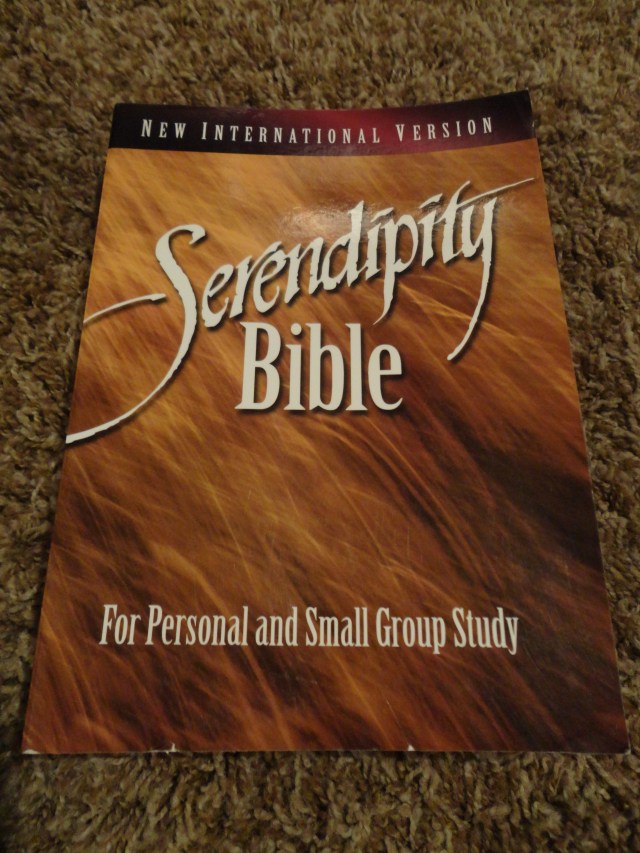
DSC02811

The Serendipity Bible

12 Steps:  The Road to Recovery – “I’m hooked, and this thing is stronger than I am.  I know I need a ‘Higher Power’ and I know that ‘Higher Power’ is God.  How can God help me break the stranglehold of this addiction?”

Option 1:  Beginner:  Bible Stories with Guided Questionnaires

  1. Going Beyond Denial – A Pharisee and a tax collector (Luke 18:9-14)
  2. Naming the Higher Power – Elijah and the prophets of Baal (I Kings 18:16-40)
  3. Coming to God – A possessed man set free (Luke 8:26-39)
  4. Confession – Josiah’s reform (2 Kings 23:1-25)
  5. Making Amends – Zacchaeus makes things right (Luke 19:1-10)
  6. An Addiction-Free Lifestyle – Crossing the Red Sea (Exodus 14:5-31)

Option 2:  Advanced: Bible Teachings with Margin Questions

  1. Going Beyond Denial – Admitting we are powerless (Romans 7:7-25)
  2. Naming the Higher Power – Confess and believe (Romans 9:30-10:21)
  3. Coming to God – Submit to God (James 4:1-12)
  4. Confession – Confess your sins to each other (James 5:7-20)
  5. Making amends – Produce fruit in keeping with repentance (Matthew 3:1-17)
  6. An Addiction-Free Lifestyle – Be careful that you don’t fall (I Corinthians 10:1-13)

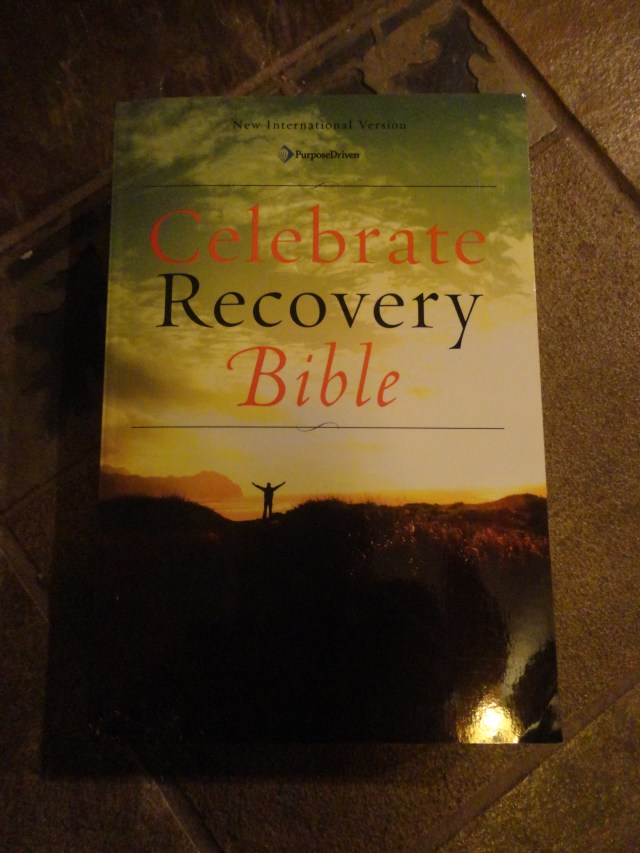
DSC02814

Celebrate Recovery Bible

Principle One:  Realize I’m not God; I admit that I am powerless to control my tendency to do the wrong thing and that my life is unmanageable (Step One).  “Blessed are the poor in spirit.” (Matthew 5:3)

Principle Two:  Earnestly believe that God exists, that I matter to him and that he has the power to help me recover (Step Two). “Blessed are those who mourn, for they will be comforted.” (Matthew 5:4)

Principle Three:  Consciously choose to commit all my life and will to Christ’s care and control (Step Three).  “Blessed are the meek.” (Matthew 5:5)

Principle Four:  Openly examine and confess my faults to myself, to God and to someone I trust (Steps Four and Five). “Blessed are the pure in heart.” (Matthew 5:8)

Principle Five:  Voluntarily submit to every change God wants to make in my life and humbly ask him to remove my character defects (Steps Six and Seven).  “Blessed are those who hunger and thirst for righteousness.” (Matthew 5:6)

Principle Six:  Evaluate all my relationships.  Offer forgiveness to those who have hurt me and make amends for harm I’ve done to others, except when to do so would harm them or others (Steps Eight and Nine). “Blessed are the merciful.” (Matthew 5:7). “Blessed are the peacemakers.” (Matthew 5:9)

Principle Seven:  Reserve a daily time with God for self-examination, Bible reading and prayer in order to know God and his will for my life and to gain the power to follow his will (Steps Ten and Eleven).

Principle Eight:  Yield myself to God to be used to bring this good news to others, both by my example and by my words (Step Twelve).  “Blessed are those who are persecuted because of righteousness.” (Matthew 5:10)

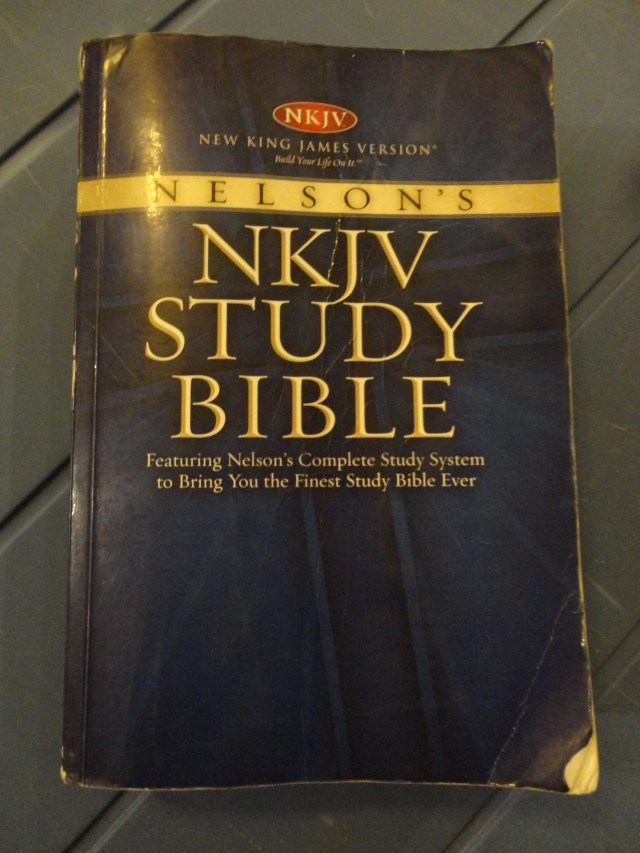
DSC02812

Nelson’s NKJV Study Bible

This Bible is connected with Pure Word and Broken Chains.

Principle 1 – I admit and accept that I have become powerless over alcohol, the substance or someone I have abused and that my life is unmanageable.

Principle 2 – I begin to believe that through Jesus Christ I can be restored to a right relationship with God the Father, and subsequent sanity and stability in my life.

Principle 3 – I make a decision to turn my life, my will, and from the things of the past, and to invite Jesus to be Lord, Savior, and manager of my life.

Principle 4 – With the help of the Holy Spirit, I humbly, boldly, and courageously ask him to search me and reveal to me the true condition of my heart.  To show me my anxieties and fears, and point out to me my sin against God and others in my life.  Only with His help can I know for sure, and in all truth, the exact nature of my sin.

Principle 5 – After recognizing the exact nature, cause, and responsibility for my sin, I’m now ready for the next step toward freedom in Christ.  I now recognize the need for accountability in order to help me maintain a truthful and open walk with Jesus and man.  Therefore, I’m willing to confess my sins to God and another person, and in doing I solidify the truth of my sin for the first time.

Principle 6 – I become entirely ready and willing to have God begin the process of removing all of the habitual sins in my life.  I realize that this process will be sometimes painful and trying, but with His help and His will working in me to conform to His image, I know with full confidence He will complete this work fully.

Principle 7 – I humbly ask Jesus to help me recognize and repent from these flaws in my character and to become more sensitive to these areas of sins in my life that I have been held captive to (John 8:34).  I also ask him to help me to learn a life of obedience rather than a feeling for desire-oriented life and receive his forgiveness for leading such a life.

Principle 8 – I make a list of all persons I have harmed and become willing and ready to make amends with them when God gives me the opportunity to do so.

Principle 9 – I make direct amends to such people, whenever possible, except when to do so would injure them or others.

Principle 10 – I continue to take personal inventories and when I am wrong, I promptly admit it.

Principle 11 – I sought through prayer and meditation on God’s Word to increase my fellowship with Him, praying continually for the knowledge of His will for me and the power of His might to accomplish it.

Principle 12 – Having been actively living out these principles and seeing the fruit of reconciliation and restoration in my life, I now desire to fulfill the command of Christ, to share him with those who are still caught in a lifestyle which subjects them to the bondage of sin and fear and to practice the Lord’s principles in all areas of my life.

Posted in daily Bible reading, devotional, gospel, Uncategorized | Tagged , , , , , , , , , , | Leave a comment

The Sower

Sower

Press Release – article – “Redefining How We Raise Resources”

Title- The Sower

Authors – R. Scott Rodin and Gary G. Hoag

Publisher – Winchester: EFCAPress, 2010

It’s a short 76 page book and a fast read.  John Howze, in charge of resource development at the Idaho Falls Rescue Mission, lent to me his copy.  It’s my first book that I have read on gathering financial resources for non-profits.

But the message of the book is much more than the typical steps and pleas in fundraising.  Requesting money is not simply about financial transactions and number crunching, it is about life transformation.  It is all about seeing hearts filled with the joy of God as they give.

Consider the words of Peter Chrysologus,

O man, send your treasure on, send it ahead into heaven, or else your God-given souls will be buried in the earth.  Gold comes from the depth of the earth–the soul, from the highest heaven.  Clearly it is better to carry the gold to where the soul resides than to bury the soul in the mine of the gold.  That is why God orders those who will serve in his army here below to fight as men stripped of concern for riches and unencumbered by anything.  To these he has granted the privilege of reigning in heaven.

Rodin authors the first half of the book, challenging the reader to grow as a sower.  With my new job at the Idaho Falls Rescue Mission, I celebrate the generous acts of giving that I see every week, for example:

  • A resident at the City of Refuge who cooks a hot, delicious meal for a city-wide ministerial luncheon.
  • A young mother who brings an overstuffed suitcase of nice men’s clothes to The ARK men’s transitional housing.
  • Businesses in town generous with their products or services.
  • Believers in local churches giving their time and finances to spread the love of Christ to those in need.

Hoag contributes to the second half of the book, laying out 12 principles for giving that correspond to the four seasons of the year.  Hoag concludes the year of God doing the fundraising for ministries with Thanksgiving.  “The culmination of harvest is the Thanksgiving feast.  At that time, the laborers’ work is done, the harvest has been bountiful and portions have been distributed to all who share in the experience.”

Now may He who supplies seed to the sower, and bread for food, supply and multiply the seed you have sown and increase the fruits of your righteousness, while you are enriched in everything for all liberality, which causes thanksgiving through us to God.  For the administration of this service not only supplies the needs of the saints, but also is abounding through many thanksgivings to God, while, through the proof of this ministry, they glorify God for the obedience of your confession to the gospel of Christ, and for your liberal sharing with them and all men, and by their prayer for you, who long for you because of the exceeding grace of God in you.  Thanks be to God for His indescribable gift! – II Corinthians 9:10-15

God accomplishes the work!  To God be the glory!

Posted in book reviews | Tagged , , , | Leave a comment

Closing the Window: Steps to Living Porn Free

porn

Title – Closing the Window: Steps to Living Porn Free

Author – Tim Chester

Publisher – InterVarsity, Downers Grove, IL 2010

I highly recommend the book for good counsel to those who have been exposed to pornography in the past and also in the assisting of those who are counseling other men (and women) caught up in the seductive snare.

Here are some brief quotes:

  1. Dr. Alvin Cooper says pornography has “the triple-A engine”: accessibility, anonymity, and affordability (9).
  2. There are five key ingredients in the battle plan:  abhorrence of porn, adoration of God, assurance of grace, avoidance of temptation, and accountability to others (17).
  3. Triggers for porn:  boredom, exposure, loneliness, opportunity, stress, tiredness, and rejection (37).
  4. “Every man who knocks on the door of a brothel is looking for God.” – G.K. Chesterton (43).
  5. “Sexual sin is not primarily about lust. . . . it is first and foremost a violation of the first Great Commandment, an idol that replaces the Creator.  This means in the face of frustration, loneliness, anxiety, stress, etc. the individual runs to a false god.” – David White of Harvest USA (44).
  6. “Whatever porn offers, God offers more” (44).

And as a guy who loves to climb mountains, this is one of my favorite illustrations in the book:

“I was presenting some seminars on the struggle with porn at the Keswick Convention in the Lake District in the United Kingdom.  During a break I climbed the mountain Skiddaw with a friend, approaching the summit from the steeper west side.  It was a hard work!  The final push is across loose rock at a forty-five-degree angle.  Each step is agony.  The calves are aching as you try to lift your weight on tired legs.  It feels like a form of torture–and this is what we do for leisure!  So why do we do it?  Why don’t we just give up?  Because we’re confident that the view from the top will make all the effort seem worthwhile.  And so it was, for me and my friend.”

“This is a great picture of the way we’re sanctified by faith.  Sometimes it can be agony.  Each step is hard work.  You feel like giving up.  But you press on, because faith tells you that the view from the top will be glorious.  Legalism would make you climb the slope by berating you or beating you down.  And if you’ve ever tried climbing a mountain with reluctant children, you’ll know that that approach doesn’t work very well.  At best you might get them up one mountain, but you’ll not get them up a second!  The gospel gets you up on the mountain by promising you a glorious view from the top.  The path is not less hard, but there’s a spring in your step as you anticipate what’s coming.  Faith is fixing your eyes on the mountain top.  Every now and then you can turn around and get a glimpse of the glorious view, just as we experience more of God the more we know him and serve him.  And those glimpses are a foretaste of what’s to come:  the mountain top of God’s eternal glory” (60-61)

Amen.

Posted in book reviews | Tagged , , , , , , | Leave a comment

The Genesis Process

Genesis

Title – The Genesis Process:  A Relapse Prevention Workbook for Addictive/ Compulsive Behaviors

Authors – Michael Dye (youtube) and Patricia Fancher

Publisher – Genesis Addiction Process & Programs (G.A.P.P.), Auburn, California, 2007 (3rd Edition)

As a Christian counselor, Michael’s philosophy is that of an integrationist.  He seeks to blend Biblical principles with relapse prevention techniques, cognitive therapy, and neurochemistry research.

  1. This workbook is not a self-help book but to be utilized in conjunction with a trained Genesis counselor.
  2. The commitment is 15 to 20 weeks.  Alongside the counselor, the one seeking help needs an accountability group, a church family, and a mentoring friend.

The journey through this recovery program involves the following order:  an assessment, confronting false beliefs, understanding one’s true identity, building life-management skills, uncovering trouble areas in one’s life history, establishing a support team (pastor, spiritual mentor, 12-step sponsor, other), recognizing dead ends, acknowledging deja vu scenarios, seeking accountability, and preparing for exodus.

The one struggling with addictions will be introduced to the term, “double binds” – I am in trouble if I do, and I am in trouble if I don’t.  But it is doing the hard thing that usually is always the right thing to do.

Also, here are some highlights from the key thoughts inserted throughout the workbook:  “Addictions create secrets which isolate you from God and others.” “Beliefs create emotions.  Emotions drive behaviors.” “Rebellion is a fear of being controlled.” “Isolation is the most prevalent common denominator in all relapse.  All relapse leads to isolation, and all isolation leads to relapse.”  “The opposite of isolation is accountability.  Accountability is the key to long-term recovery and personal growth.” “Switching addictions is like changing seats on the Titanic.”

Throughout the instruction, the authors utilize charts, questions, homework, and memory verses such as Proverbs 3:5-6, 19:20, 23:7, Exodus 20:1-5a, Philippians 4:8, 13, Hebrews 10:24-25, Romans 7:15, Romans 12:2, James 1:22-25, and Colossians 3:13.

Posted in Uncategorized | Leave a comment

The Gift of Apples

DSC02721

In the Rescue magazine (Sept./Oct. 2015) of AGRM, Brian Romano writes,

“In a recent article by Medical News Today, apples are listed as one of the top 10 healthy foods and are often called a ‘miracle fruit.’ They are extremely rich in antioxidants, fiber, B-complex vitamins, vitamin C, and other minerals such as calcium, potassium, and phosphorus.  Apples have also been known to produce healthier teeth, improve neurological health, reduce cholesterol, prevent gallstones and cataracts, and boost the immune system.  In addition, apples also potentially prevent or reduce the risk of dementia, stroke, diabetes, Parkinson’s disease, and several types of cancer” (18).

Share your apples at the Idaho Falls Rescue Mission.

DSC02726

Posted in Idaho Falls Rescue Mission | Tagged , , , , | Leave a comment

Earliest draft by KJB translator Samual Ward

Samuel Ward

Jeffrey Alan Miller writes an interesting article on his discovery of Samual Ward‘s draft on I Esdras and Wisdom 3-4 in the 1611 KJB.

Posted in Bible | Tagged , , , , | Leave a comment

Berean Baptist Church seeking a pastor

pastor search

Berean Baptist Church in Idaho Falls, Idaho seeks a pastor who will strive to strengthen the body in the following ways:
• Prepare and compellingly deliver multiple expository lessons and sermons weekly. (BBC has adopted for teaching purposes the NKJV Bible.)
• Extend hospitality toward members, regular attenders, and visitors of the church.
• Faithfully and lovingly follow the biblical model of church discipline.
• Develop among the body ministries to spiritually reach out to the community.
• Teach, model and encourage increasing congregational unity.
• Recognize and disciple faithful men to become and serve as fellow elders.
• Transition the church leadership from its present pastoral board (pastor and deacons) to a spiritual leadership consisting of the pastor and multiple elders, meanwhile maintaining and expanding the role of deacons in overseeing various practical ministries within the church.
• Strive to bring about coordination of the various ministries of the church.
• Encourage and direct the personal involvement of every member in accordance with the needs of the church and each individual’s spiritual gifts.
• Solicit and promote local church membership through a system of teaching and membership candidate interviews.
• Encourage and maintain a ministry of reverent music focused upon songs that, rather than merely imitating current secular trends, are rich in doctrine and the praise of God’s divine nature.
• Develop a ministry of biblical counseling staffed by the eldership and/or others among the congregation who are appropriately qualified.

Would you pray about this?

Posted in pastoral search | Tagged , , , , | 1 Comment