Beware

This morning with Emmaus Road Church along the river in Idaho Falls . . .

Pastor Beau Floyd taught Deuteronomy 29:16-29.  He began the message by stating that it is confession time.  The church family called out some of our idols.

Beau’s exposition of the text followed this outline.

Revelation: A Warning Against Idolatry

  1. A Warning Against Individual and Corporate Idolatry
    1. A Description of the “Poisonous Root”
    2. God’s Judgment on the “Poisonous Root”
  2. Revelation for the Next Generation and the Nations
  3. God Conceals, and God Reveals

In the first point, Beau emphasized that either in judgment or warning, God’s intention is to get His people to direct their eyes to Him.  Now our tendency is to easily point out the idols in other people.  But do we know what are our idols?  And is there anyone in our lives who knows our weaknesses and would tempt us to draw away from God?  The “Poisonous Root” boasts, “I shall be safe, though I walk in the stubbornness of my heart.”  In modern lingo, this is basically saying, “Jesus and I are good, but I can reject truths and do things that are unbiblical.”  Beware the messenger of a false gospel.  Paul echoes this in Galatians 1:6-9 (I think also of the “uprooting” of false teachers in Jude 12).  There are “spiritual” leaders out there who claim to be nourishing but they are actually sending poison.  God will judge these people because He is a jealous God (I think of Exodus 34:14).  God is passionate that your heart be not given over to a false god.

In the second point, Beau pointed out how the rulers and leaders are deported in judgment.  But there is a faithful remnant (poor as they might be) who will continue to proclaim the gospel to the next generation and the nations.

And third, Beau concluded the message with Deuteronomy 29:29.  There is much that we don’t know about God.  For example, Beau illustrated this with the life of Job.  Job didn’t understand what was going on during all the heartbreaking mess in his life.  So how did God answer him?  He gave questions to Job (I went to the concluding chapters of Job and circled 41 questions marks).  Frankly, God is the One who asks the questions.  And we don’t know the answers to any of them.  Are there difficult circumstances in your life that you don’t understand?  Remember.  When God doesn’t answer our questions, it is not because He doesn’t love us.  He is simply so much bigger than us.  And He does have a plan.  And He is altogether good.  Also, in regards to the things that you do know by His grace, hold fast to that.

Here are some interesting quotes that I came across associated with today’s text:

  • “No man is an island”
  • “As a community, Israel would stand or fall; as a community, it would experience blessing or cursing. . . . The health and vitality of the whole community depended on the health and vitality of the religious commitment of each individual within it.” – P.C.Craigie
  • “There is scarcely a threatening in all the book of God that sounds more dreadful than this.  O that presumptuous sinners would read it and tremble!” – Matthew Henry
  • “Let us seriously ponder these things in the divine presence. Let us honestly search out the root of all this lamentable failure, and have it judged and put away, that so we may more faithfully and unmistakably declare whose we are and whom we serve. May it be more thoroughly manifest that Christ is our absorbing object.” – C.H.M
  • Timothy Keller authored a provocative book entitled, Counterfeit Gods:  The Empty Promises of Money, Sex, and Power, and the Only Hope That Matters (2009). He delves into theological idols, sexual idols, magic/ritual idols, political/economic idols, racial/national idols, relational idols, religious idols, philosophical idols, cultural idols, and deep idols of power, approval, comfort, or control.

My questions related to today’s text in Deuteronomy 29:16-29:

Observation

  1. What two things are you called upon to beware in verse 18?
  2. To say, “I shall be safe, though I walk in the stubbornness of my heart”, leads to what?
  3. The curses of the covenant are written in what?
  4. What cities are listed in verse 23?
  5. How does the text describe LORD’s first action in verse 28?
  6. What are the things which belong to the LORD?  And what belongs to us?

Interpretation

  1. What were the idols in Egypt?  The idols of the Canaanites?  What do idols look like in modern-day Israel?  What about in American culture?
  2. Can one bad “root” (v. 8) lead to a whole community “uprooted” (v. 28)?
  3. Where does the New Testament talk about a “root of bitterness”?
  4. Can your name be blotted out from heaven?
  5. What and where are Admah and Zeboiim?
  6. How do you interpret verse 29?

Application

  1. How is the Church tempted to turn away from God and serve the gods of the nations?
  2. What idols personally tempt you?
  3. Is a Christian free to sin presumptuously?
  4. How might your sins affect others?
  5. What has God revealed to you?  And what do you still not know about God?
  6. Are there some things that you will never comprehend about God?
Posted in Emmaus Road Church, Inductive Bible Study | Tagged , , , , | Leave a comment

Moses summoned Israel (Deut. 29:1-15)

This morning with Emmaus Road Church along the river in Idaho Falls . . .

Pastor Beau Floyd taught Deuteronomy 29:1-15.  He began the message by asking for the purpose in why God reveals Himself to us, followed by the question over what is revelation.

God reveals Himself in various ways so that we might have relationship with Him.  He can show Himself mightily in the signs and wonders or declare His love by taking care of the small needs in our lives, like not letting our clothes wear out.  His revelation stretches from the great to the mundane.

Truly, God gives us everything we need.  For Israel, He provided victory from enemies.  He gave them land where they could build and live with their families.  And the list goes on.

Therefore in light of all God’s gracious dealings, the leaders of Israel all the way down to the little ones were to stand in covenant with Yahweh.

In light of today’s message, I renewed my covenant with Jehovah God.  Today.

It is for us to share with our kids what God has done.  It is time for us to pay attention to the divine details. It is time for us to take up our cross daily and live as the Lord’s disciples.

My questions related to today’s text in Deuteronomy 29:1-15:

Observation

  1. Where is the land of Moab? Horeb?
  2. What did Israel see in Egypt?
  3. How many years were the children of Israel in the wilderness?
  4. Who are Sihon and Og?
  5. Why are the Manassites only a half-tribe?

Interpretation

  1. Why is LORD in all capital letters?
  2. Why did the LORD not give Israel a heart to understand or eyes to see or ears to hear? (v. 4)
  3. How come Israel did not eat any bread or drink any wine? (v. 6)
  4. What does it mean to prosper in all that you do? (v. 9)
  5. Are there multiple covenants?  (By the way, I really appreciated Pastor Beau’s discussion on this today.)
  6. What should be the relationship to the sojourner? (v. 11)
  7. “Whoever is not here with us today” (v. 15) – who could that be referring to?

Application

  1. What have you seen with your eyes concerning God’s work in Idaho Falls?
  2. Who will you share that with this week?
  3. Are there words of God’s covenant that you have not kept?  Where do you need to return to the heart of God?
  4. How would you describe a daily walking with God in covenant?  How do you intentionally seek to do this daily?  In a personal way?  In community with others?
  5. How do you include your spouse?  Your kids?  Those who work with you or for you?
  6. How is God establishing you and those around you who believe in Jehovah?
Posted in Inductive Bible Study | Tagged , , | Leave a comment

The Joseph story

  • “It is through affliction rather than prosperity that God’s people bear fruit (2 Cor. 6:10, 12:9-10; Heb. 12:11).”(67)
  • Behold, I will make you fruitful and multiply you, and I will make of you a company of peoples and will give this land to your offspring after you for an everlasting possession“(Gen. 48:4) – “The grace of this catches us off guard–what God has called his people to do, he undertakes to fulfill himself.  What he demands of us, he does for us.  Such is the way, of course, that God’s gospel works.  All that he demands of us–not only multiplying but the entire keeping of the law–he himself undertakes for us in his Son.”(69)
  • “Even when evil seems to triumph most horrifically, God is there.  He is with his people.  He is working out his redemptive purposes.” (72)
  • “Joseph responds, ‘Do not fear, for am I in the place of God?’ (Gen. 50:19).  The answer to that question had to be no, for Joseph knew that he, a man, could not rule or judge in the place of God.” (72)

– quotes taken from the Gospel Transformation Bible

Posted in Uncategorized | Leave a comment

Emmaus Road Church

In the church service this morning at the Emmaus Road Church meeting place situated along the banks of the Snake River in Idaho Falls, Pastor Beau Floyd taught through Deuteronomy 28:1-14, fleshing out the blessings for covenant faithfulness.

God’s purpose is to bless His people for His glory as a testimony to the nations.

God’s people are . . .

  • Blessed at Home and at Work (vv. 3, 6, 8)
  • Blessed in “Fruit” (vv. 4, 11)
  • Blessed in Provision (vv. 5, 12)
  • Blessed in Travels (v. 6)
  • Blessed Sevenfold Against Enemies (v. 7)
  • Blessed in Identity (vv. 9-10)

Pastor Beau taught the text within the scope of Israel’s covenantal relationship, applying certain aspects to the Church and yet carefully separating our thinking from the hastily drawn conclusions of pursuing a personal “prosperity gospel” based on greed or a collective American militarism based on pride.

Our God is good.  Every good thing about us and what we have is directly sourced in God.  As John the Baptist stated in John 3:27, “A person cannot receive even one thing unless it is given him from heaven.”  And Jesus declares to us in John 15: 5,

I am the vine; you are the branches.  Whoever abides in me and I in him, he it is that bears much fruit, for apart from me you can do nothing.

This week, we must not doubt God’s goodness and His steadfast love (hesed), that only sets us up to pursue the empty pleasures of false gods, tragically placing us out of the realm of God’s rich blessings.  We must trust and obey our loving God.  And may the blessings that we experience be an attractive witness of God to those around us.

Do you need a blessing from God?  Don’t work for it.  Just ask your loving Father.  To Him be the glory!

“Blessing, true blessing, real shalom, is ours for the asking–as long as we resist the urge to try to help pay for it.” – Mark D. Futato


Posted in Uncategorized | Leave a comment

Gospel Transformation Bible

In 2017, I am reading through the Gospel Transformation Bible.  In its back pages, there is a reading plan that takes you through the whole Bible from Genesis to Revelation in a year.  If you don’t have a reading plan for this year, join me.  I plan to highlight notable quotes from the study notes throughout the year.  In the past two weeks, here are some of my favorite observations to accompany the Biblical text:

  • “The early church confessed readily that the Father, the Son, and the Spirit were all involved in the work of creation, reinforcing early Christian beliefs about the Trinity” (p. 3).
  • “Jesus Christ, however, as the second Adam, fulfills God’s image-bearing purposes and enables God’s people to do the same” (5).
  • “God can do more with our six days than we can do with all seven.  So we can and should rest in him” (7).
  • “The account of Noah ends on a strange note, as he winds up drunk and naked in his tent (vv. 20-21), with an immoral (cf. v. 22 and Lev. 18:6-18; 20:17) and dysfunctional family being divided by cursing and blessings (Gen. 9:22-27).  Even a man as great as Noah required mercy from God” (15).
  • “Leaving our moral resumes at home, we are invited into God’s shining favor if we will bring nothing to him but our need, with trust in his ultimate care.  It is Christ-trusting sinners, not the self-trusting ‘righteous,’ who are the children of Abraham and are entitled to all the promises God made to Abraham (Mark 2:17; Luke 19:10; Gal. 3:26-29)” (23).
  • “Strong in body and weak in soul before wrestling God, Jacob was now weak in body and strong in soul” (49).
  • “Jacob was the appeaser; he simply wanted no trouble. . . .The gospel grants courage to those of us tempted to appease through passivity, for if God has been appeased through Jesus, we need not be concerned with appeasing others” (51).
  • “The apparent hiddenness of God does not indicate the uncaring absence of God” (55).
  • “Felt or unfelt, seen or unseen, in sin or success, God is with us” (58).

Thank God for His presence and His hope through the gospel in these opening chapters in Genesis.


Posted in Uncategorized | Leave a comment

Three Questions

The conclusion of how the apostle Peter ends his second letter has been on my mind.

“But grow in the grace and knowledge of our Lord and Savior Jesus Christ.  To him be the glory both now and to the day of eternity.  Amen.”

There are three questions that are good to ask one another:

  1. What is God teaching you in your reading and memorizing of God’s Word? We read God’s Word because we trust that God has the best answer to our heart issues.  He cleanses us from sin and shows us the way.  And it is by hiding God’s Word in our hearts that we are strengthened in our battle against sin.  In the years past, I have utilized The NKJV Daily Bible.  I have liked this plan for its easy access to the daily reading and the mix of OT, Psalms, Proverbs, and NT selections.  This gives me a daily dose of law & prophets, worship, wisdom, and church instruction. Watersprings Church has developed this schedule into a three-year reading plan.  Basically, you read 3.2 chapters a day to read the Bible in one year or 1 chapter a day to read the Bible in three years.  Personally for the year 2017, I will be departing from my traditional yearly schedule by following the daily Bible reading plan tucked in the back pages of the Gospel Transformation Bible.  For any heart sanctification, we must dig deeply into heaven’s responses to these questions:  what to do? where to do it? why to do it? and how to do it?  And I think lasting transformation comes especially by being anchored in the answers to the last two questions as the Holy Spirit does spiritual heart surgery.
  2. What are you praying for and with whom? It is crucial that we be daily praying alone to our good and great God. And weekly I think it is important that you gather with other believers for prayer.  Our prayers reveal our dependence upon God.  We cannot even begin to do life in 2017 on our own.  Let us covet one another’s prayers.
  3. Are you faithfully gathering and serving Jesus within the context of a local church family? Activity in parachurch ministries provide immense satisfaction in our daily service for the King.  Christian nonprofit organizations existing as parachurch ministries bring about extremely helpful, specialized blessings to the community.  But the parachurch ministry is not Christ’s Church.  Every believer in Jesus must be rooted, established, loving, and serving in a local church family. As I was telling a friend today, Christ’s church in Idaho Falls is God’s gift to Jesus people.

God bless you all in the coming year.  May God’s Word be a lamp for your feet.  May the Spirit move mightily through your prayers.  And may God place you as living stones within His house.  May we grow in Jesus.

roots by the river in the city,

E.T.W.

Posted in Uncategorized | Leave a comment

Miracles in the Margins

Bible Text:  Luke 17:11-19

So Jesus answered and said, “Were there not ten cleansed? But where are the nine?  Were there not any found who returned to give glory to God except this foreigner?” (vv. 17-18)

Place:  City of Refuge (under the umbrella of the Idaho Falls Rescue Mission) in Downtown Idaho Falls, 5:30 pm, Sunday evenings

1.We all need mercy.

** have mercy on us! – Cf. 16:24;18:38,39; Mt. 9:27; 15:22;17:15;20:31; Mk 10:47,48.  This was a common plea from those desiring healing. – MacArthur Study Bible

And thankfully, His mercies are new every morning.  Great is his faithfulness

2. Ten percent of those receiving mercy in this story express thanks.

Where were the nine?  Could it be?  (1) They felt their healings were deserved, or (2) make sure with their priests that everything was good, or (3) preferring law before love, or (4) not wanting to mingle again with the Samaritan, or (5) the decision that they would express their thankfulness only in their hearts?

This sin of ingratitude seems to be a common sin.  And ingratitude can quickly turn a generation of people into heathens (Romans 1:21).

** “giving Him thanks” (v. 16) – Elsewhere in the NT such giving of thanks (Gk. eucharisteo) is always directed to God (in every one of 37 other occurrences of this verb) – ESV Study Bible

3.The real miracle comes to the one living in the margins.

** The Greek word for foreigner is allogeneis, (allos plus genos), “man of another nation” (or race), foreigner.  In the temple at Jerusalem this word was included in a warning, addressed to non-Israelites, to proceed no farther toward the interior than the Court of the Gentiles.  The inscription in Greek and Latin reads: “Let no man of another nation enter inside the barrier and the fence around the temple.  Whoever is caught will have himself to blame that his death follows.” – Hendriksen

Jesus can easily turn things upside down and reveal that some of the greatest expressions of thankfulness can come from the most unlikely people, the outsiders of the organized religion. See also Luke 4:25-27, 7:9, 11:30-32.

The Jews snatched up the lesser, but the Samaritan received the greater.

Notable quotes:

  • “Who are we, that we should draw near to him that is infinitely pure?” – Matthew Henry
  • “Jesus has mercy on social outcasts” – Walter Liefeld
  • “The only who exhibited gratitude was a despised schismatic” – Alfred Plummer
  • “He fell on his face and thanked Jesus, for in the Master he recognized God’s Representative, God’s power and love operating through Jesus.” – William Hendriksen
  • “The first and greatest response to the gospel of grace is thankful worship” – Gospel Transformation Bible (ESV)
  • “He who has received only blessings from His hand and does not come close to Him in humble but heartfelt gratitude will always forgo what is the highest and most glorious in life.  But he who, on receiving gifts out of His hand, turns to the Giver Himself in real gratitude, will partake of fullness of life and happiness.  There is nothing that can bind one more closely to Him than sincere gratitude–“we love him because he first loved us.” – Norval Geldenhuys
  • “He had been loud in prayer (ver. 13), so now he is loud in praise.  His impurity had kept him at a distance from Christ, but now that he is cleansed he falls at the Saviour’s feet.” – J. Willcock


Posted in devotion | Tagged | Leave a comment

Death is unpredictable

Today was supposed to be a birthday celebration for my brother-in-law, Blue Sky Falconer, as he turned 42 years old.  Sadly because of cancer, he died one month ago.  It is hard to believe that he is gone.  And it is easy to question why this could happen.

So I turn to Job in the Bible, the one who struggles under immense suffering.  He questions God.  He firmly believes in God.  He knows that God is powerful and just.  But he is simply having a difficult time trusting God’s goodness and love toward him personally.

Ironically, even with all of Job’s questions, the fact is that God doesn’t answer one of them.  Instead, God asks Job a whole series of questions, which in turn cures Job of challenging God.

In my morning reading in The NKJV Daily Bible, these two questions in particular spoken by God to Job have been in my thoughts yesterday and today:

“Have the gates of death been revealed to you?  Or have you seen the doors of the shadow of death?” (Job 38:17)

Do you know the answer to those two questions.  I don’t.  I have no control over death.  I can’t even predict death.

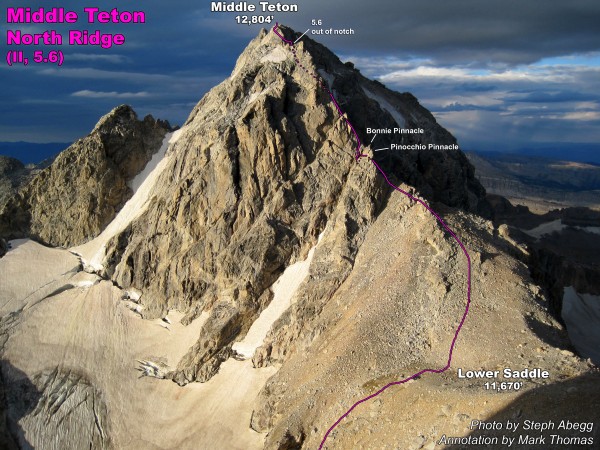
This past weekend, my youngest son and I hiked the Middle Teton.  Interestingly, on the summit, we struck up a conversation with an Exum guide and another girl, possibly his wife, who came up the Northern route of the Middle.

middle

They had come from the summit of the Grand and where making their way over to summit the South Teton in order to complete a full traverse in one day.

I started telling them about the sad story I read in our local newspaper about the climber, Gary Falk, who died on the Grand last month.  Gary died at the age of 42.  My new friend up on the mountain top responded to me that Gary was his colleague.  Who would have predicted that July 23, 2016 would be Gary’s last day on earth?  I lifted up a prayer for his wife and kids.  Gary is remembered here on facebook.

As creatures, we cannot predict when the doors of death open.  But there is One who does know.  I don’t even begin to comprehend the number of days that each one of us has to live, but God does.  He encompasses both the beginning and the end of our lives here on earth.   He knows all about Sheol.  He transcends Hades.  So on the birthday of brother-in-law, I leave my questions with God, for I certainly cannot even begin to answer any of the questions that God would put forth to me.


Posted in Uncategorized | Leave a comment

Sackcloth & ashes?

I have a young nephew named Ocean Falconer.  He has special needs.  He is an awesome boy.  Many call him, “the Big O”. At the age of 41 on Wednesday, July 27, 2016, his dad, Blue Sky Falconer, died of cancer.  Even though my nephew does not speak in full sentences, he understood completely what had happened.

Ocean1

(picture credit – Tom Wilson)

The day after his dad’s memorial service on Wednesday, August 3, Ocean sat down in the outside yard of his house, holding his daddy’s picture.  Tears trickled down his cheeks.

In such a moment, how would you have comforted my nephew?  Perhaps one could just sit down in the yard and shed a few tears, too.  In times of mourning, those tears are “liquid prayers” heard by the angels and God Himself on the throne.

In the West, we are rather subdued when it comes to our mourning.  As an introvert, I can actually be stone quiet.  But I am deeply struck by how some in the East mourn.  Where I would keep it in, they let it all out.

Those in the Bible responded to death or even to the verdict of death with sackcloth and ashes.

  1. For they had made an appointment together to come and mourn with him, and to comfort him.  And when they raised their eyes from afar, and did not recognize him, they lifted their voices and wept; and each one tore his robe and sprinkled dust on his head toward heaven.  So they sat down with him on the ground seven days and seven nights, and no one spoke a word to him, for they saw that his grief was very great” (Job 2:11b-13).
  2. When Mordecai learned all that had happened, he tore his clothes and put on sackcloth and ashes, and went out into the midst of the city.  He cried out with a loud and bitter cry.  He went as far as the front of the king’s gate, for no one might enter the king’s gate clothed with sackcloth.  And in every province where the king’s command and decree arrived, there was great mourning among the Jews, with fasting, weeping, and wailing; and many lay in sackcloth and ashes” (Esther 4:1-3).

I don’t know why we would think it so strange in the West to wail or to put on sackcloth and ashes when we mourn.

The closest thing to a Church in the West experience is once a year on Ash Wednesday placing a little ash mark on your forehead.

We know it is appropriate for the summer 2016 Olympians in Rio to weep or shout in the midst of triumph or defeat.  So I am telling you, it is definitely OK to wail, shout, and tear your clothes in the midst of death.


Posted in Uncategorized | Leave a comment

Death, my friend?

How many of you have watched a movie where the main character is fully intertwined with a disturbing psychosis or a painful physical disability or disease?  How the movie unfolds will depend largely upon the philosophical choices about life and death believed by those producing the show.  You might see the main character fight for life.  Or you just might watch the character deliberately seek out a sympathizing organization and friends who will assist and hasten death.  Is death your friend or your enemy?

In the Star Wars saga, I believe that Yoda says something rather hollow, “Death is a natural part of life.  Rejoice for those around you who transform into the Force.  Mourn them do not.  Miss them do not.  Attachment leads to jealousy.  The shadow of greed, that is.”  So would you invite Yoda to come speak to your family in a memorial service as you remember a loved one who has died?

On the other hand, let me look at this from another angle.  In the natural world, I do find some beauty in death.  There is a Japanese type of art labelled Wabi-sabi – where one “pursues beauty in imperfection and profundity in nature and embraces the natural cycles of growth, decay, and death.”

As an illustration, my youngest boy and I drove recently to the top of the Teton Pass, parked our car, and hiked to the top of Mt. Glory.  On this mountain, you will see that the marred, asymmetrical, twisted or dead trees are just as breathtaking in their structure and beauty as the properly proportioned living trees.

DSC_0379

And in observing humans, I would be bold enough to say that the wrinkled, blemished bodies of aged grandparents are more beautiful than the hottest bodies in Hollywood.  Physical perfection is so overrated in America, especially in the I-15 Corridor of the Intermountain West.  My young Idaho pastor friend, Christopher Leavell, who died last year of cancer, portrayed the art of Wabi-sabi so well in his photography and in his life.

But as I acknowledge this Japanese perspective, it is not to undermine what I believe about death itself.  Where Sherwin Nuland writes, “Death is not the enemy, disease is.”  I wholeheartedly disagree.   Death is not my friend.

Death is not natural.   And human death is even worse than the death of trees.  When I cut down a tree in my backyard, I might have ten new shoots spring up.  When a man or woman is cut off (dies), it is the end.  The person does not pop up again; there is a sad finality.

Some of the ancient biblical writers had nothing good to say about death.  One of the reasons they abhorred death is because they would be removed from giving testimony to the truth and glory of God among the people.

  • King David reasoned with God, “For in death there is no remembrance of You; in the grave who will give You thanks?” (Psalm 6:5).
  • “What profit is there in my blood, when I go down to the pit? Will the dust praise You?  Will it declare Your truth?” (Psalm 30:9).
  • When King Hezekiah miraculously recovered from a terminal illness, he declared, “For Sheol cannot thank You, death cannot praise You; those who go down to the pit cannot hope for Your truth. The living, the living man, he shall praise You, as I do this day” (Isaiah 38:18).
  • The wise preacher in Ecclesiastes urges, “Whatever your hand finds to do, do it with your might; for there is no work or device or knowledge or wisdom in the grave where you are going” (Ecclesiastes 9:10).

So the question is do we fight for life because we hate death or do we resign ourselves to death because we think it is our friend?

I recently read a story in our local newspaper about a woman in California who threw a party with her friends before committing herself to an assisted suicide.  Then I compare this to my brother-in-law who fought terminal cancer all the way up to a few days before his death.

I will never forget the courage my brother-in-law displayed.  He climbed his home stairs like one in the death zone of Mt. Everest.  Every step took effort as his body craved oxygen.  He ate and drank with determination.  He fought for life.

I see this issue as black and white.  Jesus is life.  Sin, the devil, and the world’s lies are death.  Thank Jesus that He died so that we can shout victory in the face of our enemy called death.

Posted in Uncategorized | Leave a comment